
Introduction
The construction industry is undergoing a massive transformation with the rise of 3D construction printer machines. From building houses in days instead of months to reducing construction costs and material waste, 3D printing technology is redefining how modern structures are built.
Today, when people search for 3D construction printers, 3D concrete printer machines, or 3D printed houses, they are looking for faster, smarter, and more sustainable construction solutions. This blog explains everything you need to know about 3D construction printer machines and why they are becoming the future of the construction industry.
What Is a 3D Construction Printer Machine?
A 3D construction printer machine is an advanced automated system that constructs buildings layer by layer using specially designed concrete or mortar mixtures. Unlike traditional construction methods that rely heavily on manual labor, these machines follow a digital 3D design (CAD model) and print structures with extreme accuracy.
| Construction Type | Description |
|---|---|
| Residential Houses | Enables fast and cost-effective construction of residential homes |
| Commercial Buildings | Suitable for offices, shops, and other commercial structures |
| Boundary Walls | Allows automated construction of strong and uniform boundary walls |
| Structural Components | Used to print beams, columns, slabs, and other structural elements |
| Custom Architectural Designs | Supports customized and complex architectural designs |
How Does a 3D Construction Printer Work?
The working process of a 3D construction printer is simple yet highly efficient:
| Process Step | Description |
|---|---|
| Digital Design Creation | A 3D model of the building is created using architectural software |
| Material Preparation | Special printable concrete or mortar is prepared for smooth extrusion |
| Layer-by-Layer Printing | The printer deposits material precisely according to the design |
| Structural Completion | Walls and structural elements are completed with minimal human involvement |
This automated process ensures consistent quality, less error, and faster project completion
.
Types of 3D Construction Printer Machines
There are different types of 3D printers used in construction, depending on project requirements
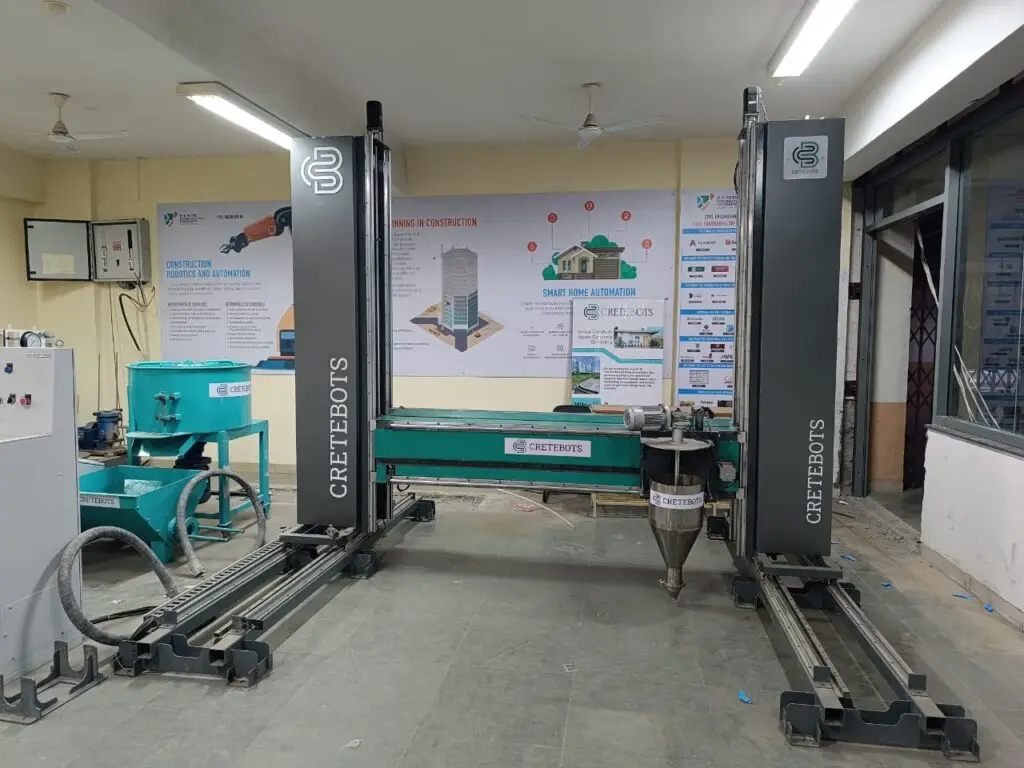
1. Gantry-Based 3D Printers
- Ideal for large-scale construction
- High stability and speed
- Commonly used for full-house printing
2. Robotic Arm 3D Printers
- Highly flexible and precise
- Suitable for complex architectural designs
- Used for custom and artistic structures
3. Mobile 3D Construction Printers
- Easy to transport
- Perfect for on-site construction
- Reduces setup time significantly
Key Benefits of 3D Construction Printer Machines
3D construction printers offer unmatched advantages over traditional construction methods:
| Feature | Benefit |
|---|---|
| Ultra-fast construction speed | Significantly reduces overall project completion time |
| Reduced labor and project cost | Lowers manpower requirements and total construction cost |
| Minimal material wastage | Uses only required material, reducing waste |
| High design accuracy | Delivers precise and error-free construction |
| Eco-friendly and sustainable | Supports green construction practices |
| Consistent structural quality | Ensures uniform strength and build quality |
Key Takeaways
- 3D construction printers revolutionize the industry by enabling faster and more cost-effective building processes.
- These machines construct structures layer by layer using digital designs and special concrete mixtures.
- Different types of 3D construction printers, such as gantry-based and robotic arm models, suit various project needs.
- Key benefits include reduced construction time, lower costs, minimal waste, and high design accuracy.
- 3D construction printers support sustainable building practices and ensure consistent structural quality.
A 3D construction printer is an advanced machine that builds structures layer by layer using special concrete or mortar based on a digital 3D design. It reduces construction time, cost, and material waste.
The printer follows a computer-generated 3D model and extrudes construction material layer by layer to form walls and structural elements with high accuracy and minimal human labor.
Most 3D construction printers use specially formulated concrete, cement-based mortar, or geopolymer materials designed for fast setting and strong bonding.
Yes. Structures built using 3D construction printers are designed to meet structural safety standards. When proper materials and engineering are used, the buildings are durable and long-lasting.
Depending on size and design, a basic house structure can be printed within a few days, which is much faster compared to traditional construction methods.
Yes. 3D construction printing reduces labor costs, minimizes material wastage, and shortens project timelines, making it more cost-effective than conventional construction.
